Building confidence one tail wag at a time
23 April 2026
There is something unique about the newest teaching assistant at AnglicareSA’s Daphne Street Childcare and Early Learning Centre – for starters, he has four legs, a glossy black coat, and a face that cannot help but make you smile.
Each week, Tommo – a calm and attentive black Labrador from Guide Dogs SA/NT – gently pads from classroom to classroom and out into the playground and is greeted with a mix of curiosity, excitement, and growing confidence.
Louise Belperio, Clinical Manager, Early Learning, said the collaboration with Guide Dogs SA/NT represented a powerful example of reciprocal impact.
“The relationship between AnglicareSA and Guide Dogs SA/NT began prior to Covid-19, however it paused during the pandemic, but this year we have re-established our connection,” Louise said.
“Tommo now visits weekly as part of his development into an Assistance Dog.
“The idea of the visits is that it is also a two-way street,” Louise explained. “It helps Tommo learn how to be around autistic children, and at the same time, it helps the children learn how to safely and confidently engage with a dog.”
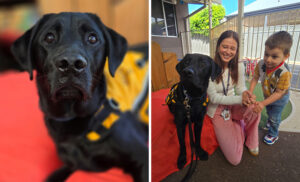
For many children – particularly those in autism-specific programs – the exposure was significant, Louise said.
Some had initially approached Tommo with uncertainty or fear, and many had never interacted with a pet before, however, over time she said that uncertainty had shifted.
“Children who were once hesitant are now eager participants, confidently engaging with Tommo and demonstrating a growing understanding of how to interact gently and safely,” Lousie said.
“We have seen real development. Children who were unsure are now excited and they have learned how to be gentle and how to approach him safely.”
While the benefits within the classroom, both for the autism specific program at Daphne Street and the mainstream childcare, were immediate, Guide Dogs SA/NT Trainer Natalie said the long-term purpose of Tommo’s visits extended far beyond the centre.
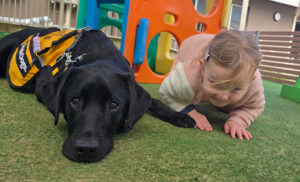
Assistance Dogs provide a unique combination of safety, emotional support, and increased independence for children and their families.
“Safety is the biggest thing,” Natalie said. “Some children can be prone to running so an Assistance Dog is trained to respond – if the child tries to run, the dog will anchor, lie down, and prevent that.
“These dogs also play a critical role in emotional regulation and confidence-building, helping children feel calmer and more secure while supporting their ability to engage with the community.
“They help children go out into the community and feel more independent.”
The relationship with AnglicareSA is an important one for the Guide Dogs SA/NT training program as it provides regular exposure to children, particularly those with diverse needs, to help determine whether dogs like Tommo are suited to becoming an Assistance Dog.
“He is learning to tolerate noise, movement, and unpredictability,” Natalie said. “The calm and gentle temperament you can clearly see is key to his potential success.”
Although Tommo is currently the only dog visiting the Centre, Louise said she was hopeful the relationship would be an opportunity to expand innovative, evidence-informed approaches within early learning.
“Hopefully this becomes a long-term relationship,” she said. “If it continues to go well, there will be more dogs like Tommo coming through.”